More than a Game: Leila Ludyka’s Path to Purpose
Date Posted: Mar 3, 2026


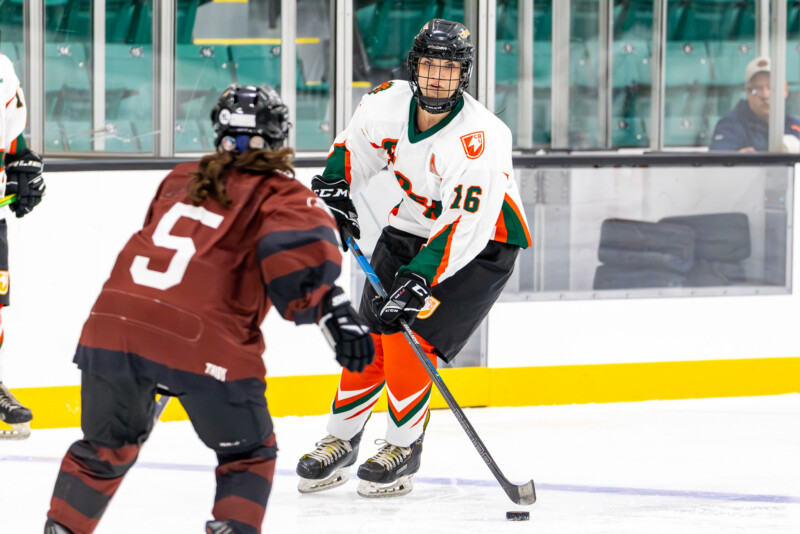 Leila Ludyka describes herself as a “Jack of all trades” who is always busy, a title she earns daily. If you took a look at her schedule, you might end up needing a nap. It is a relentless mix of 6:50am hockey practices, university classes, coaching shifts, game-day operations and more. If you’re wondering how she pulls it off, Leila says it runs in the family.
“My mom and dad are equally as busy. Basically, none of us are ever sitting down,” Leila says. “It’s always been go, go, go, go, which I can’t complain about. If I have five seconds, I’m bored.”
That kind of boredom is rare for Leila, now in her fourth year of Sport and Physical Activity Leadership (SPAL) studies at Cape Breton University. On the ice, she anchors the blueline as an Assistant Captain of the CBU CAPERS women’s hockey team. Off the ice, she serves as the Operations Manager for the Cape Breton Blizzard Female Hockey Association and can be seen behind the bench helping to coach the Blizzards’ U13 A team.
But the path that led Leila to become a central figure on campus and in Cape Breton’s female hockey community was never part of the original plan. When Leila first enrolled in the Bachelor of Arts Community Studies (BACS) program at CBU, she wasn’t looking for a career in sport leadership. She was just killing time.
“You had to be 19 to go to the police academy. I was like, ‘I don’t want to take a year off, so I’m going to go in, I’m going to do a year, get that under my belt and leave,'” she says.
A Change of Heart and Career
That perspective shifted once she immersed herself in her studies. The classroom experience offered Leila a point of view of the sports world she hadn’t considered before and a sense that she could offer something beyond just playing the game.
“I got here and I was like, ‘Oh, I kind of like this a little bit,'” she says. “But if I didn’t have this (hockey) background, this knowledge under my belt, I probably wouldn’t have been as comfortable doing all of the things I’ve done.”
That comfort level was tested and proven earlier this month when Leila took on a massive role at the 2026 IIHF U18 Women’s World Championship. Originally slated to be a standard volunteer, she was asked to step up as the Chair of Volunteer Operations and Experience. Suddenly, she was a key logistical operator working directly with Hockey Canada to manage the experience for eight international teams. The exposure to the professional side of hockey operations was intimidating, but also a revelation.
“It was one of those moments of like, ‘Oh my God. Change.’ That was terrifying,” Leila says. “Being from Cape Breton, you didn’t really hear or see a lot of Hockey Canada stuff, so that was never really an option that was presented to me growing up.”
Leila says the experience has given new shape to what she considers herself capable of.
“Since the end of it, I’ve kind of changed my whole career path plan to something more hockey-related compared to my original path,” she says. “The more and more I started doing hockey stuff off the ice, I saw how I’ve dedicated so much of my time and realized there’s so much good that can be done with it.”
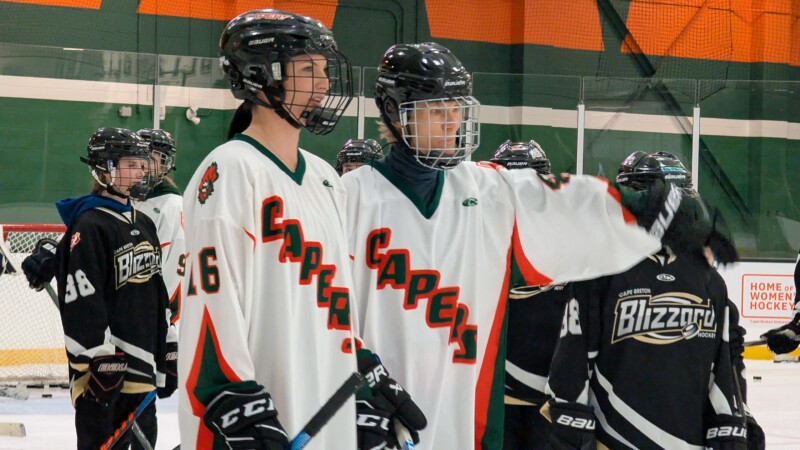 Connecting Theory to Practice
Leila credits her ability to handle these high-pressure environments to the interdisciplinary nature of her learning at CBU.
“We have the opportunity in the SPAL program here to learn a little bit of physio, learn a little bit of kinesiology, learn a little bit about policy, a little bit about facilities,” she says. “Getting all of that overall knowledge has something more to bring than just a specialization.”
She finds herself applying this constantly, whether she is analyzing sport policy at the rink on a weekend or managing the complex emotions of the U15 players she coaches on the Cape Breton Blizzards, something Leila says was lacking from coaches when she was playing minor hockey.
“I find that when I first started in sports, it was very much, ‘Keep your emotions in check.’ Like the saying, ‘There’s no crying in baseball.’ It was literally that kind of environment,” she says.
Today, Leila uses what she’s learned as a SPAL major and Psychology minor to take a different approach.
“Kids are so much more in touch with their mental health, their feelings. They’re explaining feelings to me that I didn’t even know how to explain at their age,” she says. “It’s knowing that we can help them and feeling confident that I have the skill set from my university experience that I can help them if they need it.”
Support from the Jennifer Keeping Centre
Her journey hasn’t been without significant obstacles. In October of 2025, Leila suffered a severe concussion during a Capers game that took her off the ice and out of the classroom for nearly two months. She describes the impact as a “double bounce” where her head hit the ice and then another player landed on top of her. The injury left the overachiever in a dark room for weeks, struggling with such significant memory loss that she had to set reminders on her phone just to eat.
It was a period that could have derailed her fourth year, but support from the Jennifer Keeping Centre (JKC) helped her navigate the recovery. Working with Angela Jagoe at the JKC and health professionals at the Nancy Dingwall Centre, Leila managed her symptoms through weekly testing and academic extensions.
“I’m an overachiever, obviously,” Leila says. “Knowing that I wasn’t able to do my midterms and stuff, I was like, ‘Oh my God, I’m going to fail, this is going to be terrible.’ But Angela was able to help me extend my studies, which took so much stress off my back”.
That relationship with the JKC has since evolved from crisis management to career development. Through the JKC’s Supported Employment Program, Leila now works as the Operations Manager for the Cape Breton Blizzards organization, a role that bridges her academic studies with her professional ambitions. On any given Saturday, Leila’s at the Kehoe Forum, paying referees and timekeepers, overseeing league games and even stepping in to help coach.
A Lasting Impact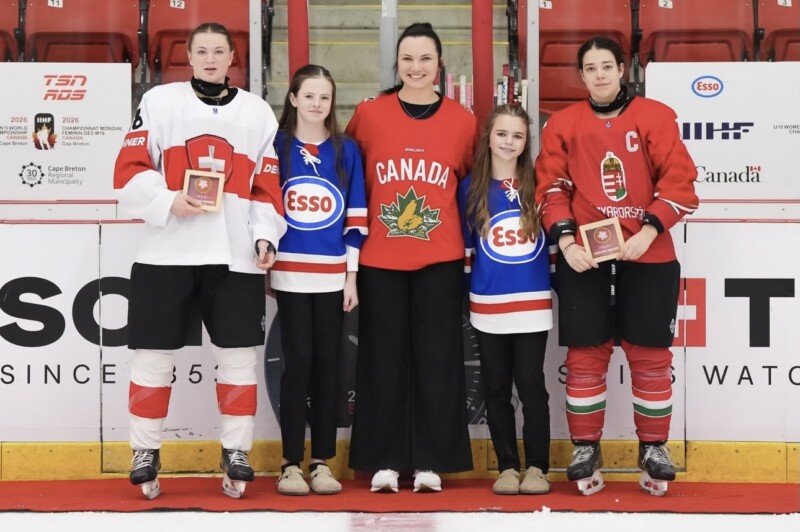
Ludyka looks at the next generation of players with a sense of pride. She remembers when local leagues were folding and the dream of professional female hockey felt distant. Now, she sees young girls in the stands of “The Home of Women’s Hockey” wearing shirts with her name on the back.
“It makes you feel like a celebrity because it’s like they’re looking for you,” she says. “I have this little kid that’s like my little best friend. She made a shirt with my last name on it for the Capers games. She wears it to every game. I will never have a word to explain it because it just gives me chills.”
For Leila, the goal is bigger than her resume. The ultimate reward is knowing she is helping to build a system that will outlast her time at CBU. It is about ensuring women’s hockey thrives in Cape Breton for generations of girls to come.
“To leave a lasting impact somewhere is so much more fulfilling than just your experience,” Leila says. “Knowing that we’re not doing it for ourselves, but for little kids and the future, is the best part of the whole thing.”
Catch Leila and the CBU CAPERS Women’s Hockey team at the Kehoe Forum, March 6-8, as they take on the Acadia Axewomen and the Holland College Hurricanes for the Atlantic Collegiate Hockey Association Championship.