My CBU Story: Shelby MacIsaac
Date Posted: Nov 4, 2025


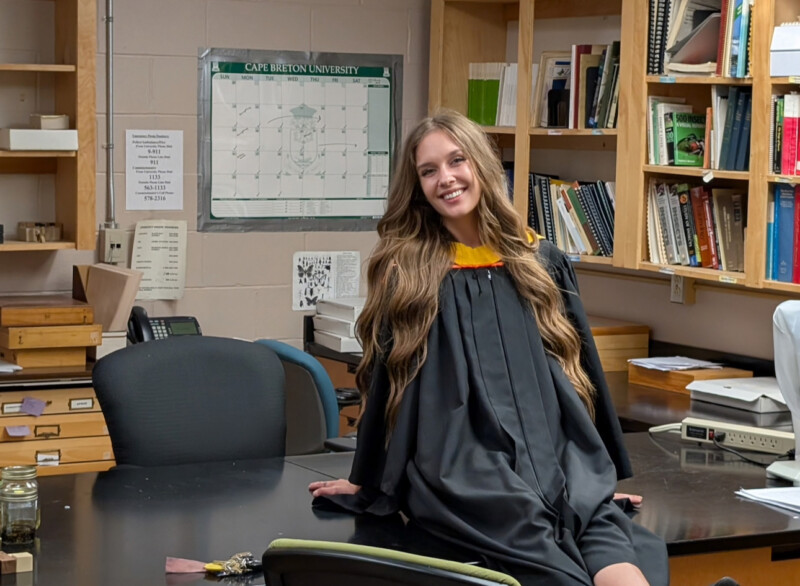 Shelby MacIsaac thought the plan was set when she returned to Sydney from McMaster University. She worked shifts at a veterinary clinic and changed her program from Social Work to a Bachelor of Science, Biology major at Cape Breton University. Shelby was on a straight track to what she thought was her dream career – a veterinarian. Life and CBU, however, had different plans for her. A decision to join a waiting list for a Monitoring Biodiversity class led her on a plane headed to Costa Rica, her first time abroad, where hands-on fieldwork turned curiosity into commitment and pointed her ambitions toward conservation.
“Monitoring Biodiversity with Dr. Alana Pindar was the moment that completely confirmed I was on the right path. I initially added myself to the waitlist because I loved her Entomology class so much, but I didn’t realize it would include an international trip to Costa Rica,” says Shelby. “That trip changed my life. Conducting biological fieldwork in the rainforest opened my eyes to the world of wildlife conservation, and from that moment on, I knew that was the direction I wanted to follow.”
Shifting Focus
Back in Cape Breton, the shift from curiosity to commitment didn’t end at the airport. When she returned to Cape Breton Shelby joined in on a Living Lab study with Nova Scotian blueberry farmers and the Nova Scotia Federation of Agriculture. She spent this time setting traps, processing bug samples, weighing biomass, identifying insects to order and comparing seasonal patterns. The technical work bridged the gap between research findings and the decisions farmers actually make.
“The goal of the study was to analyze and compare insect biomass collected from shelter belt and non-shelter belt sites within blueberry fields using Malaise traps, in two-week intervals from various sites,” Shelby says. “The most valuable thing I learned during this project was how to translate data into impact, connecting scientific results with real-world meaning.”
That research also inspired Shelby to make communication skills a key part of her researcher’s toolkit. After months of rinsing, drying and counting, Shelby took the story of pollinators to an elementary classroom, turning lab work into plain language and pictures students could carry home. Shelby sees that kind of direct education having a possible ripple effect that could be a game-changer.
“The students responded so positively, and it was extremely rewarding to share something so meaningful that helped them understand that insects aren’t scary, and how crucially important pollinators and insects are to the world we live in,” Shelby says. “I firmly believe that educating youth on these topics is one of the most effective ways to promote a positive approach to science education and help protect the planet in the face of the current climate crisis.”
“Her support changed my life.”
Mentorship powered the change. Shelby is clear about who opened the door for her and then stood beside her as plans shifted. She credits Dr. Alana Pindar with creating a classroom culture that allowed Shelby to grow alongside her ambitions. Later, when Shelby’s new path needed confidence, the support held.
“Professor Pindar didn’t just teach a class; she gave a large group of students a truly life-changing experience,” Shelby says. “Her classes changed my career, and her support changed my life. I can say with absolute certainty that I would not be where I am today without her.”
There were hard calls along the way. Letting go of the veterinary plan meant stepping back from work and rebuilding her academic routine around labs, field notes and research questions. In her view, the choice to focus paid off.
“One of my biggest challenges was stepping away from the veterinary path that I had built my entire life around, but stepping back from work gave me the opportunity to fully engage with school in a way I never had before,” she says. “I gained strong research and analytical skills, but also confidence, adaptability and resilience.”
What’s Next?
By the time the semester turned over, the through line was solid: a waitlist seat became fieldwork, fieldwork became research at home, and research became outreach that made the science land with real people. Shelby traded clinic shifts for lab benches and rainforests, building a researcher’s and conservationist’s toolkit that pairs careful data with clear communication and a purpose that now points beyond veterinary medicine.
“I have a six-week Costa Rica trip planned just three days after convocation, where I’ll be volunteering with a sea turtle conservation organization,” she says. “This experience will help me prepare for my next major goal, pursuing a Master’s degree in International Wildlife Conservation.”
If she has a message for students sitting where she once sat, it’s simple and hard-won.
“Never give up. Your career path might change, even more than once, and that’s okay!” And keep an eye on the moments that matter. “You never know which moment might change your entire life!”
Congratulations to Shelby and the entire graduating class of Fall 2025