Medical Student Examines Use of Bedside Ultrasound in Hospitals
Date Posted: Nov 2, 2026


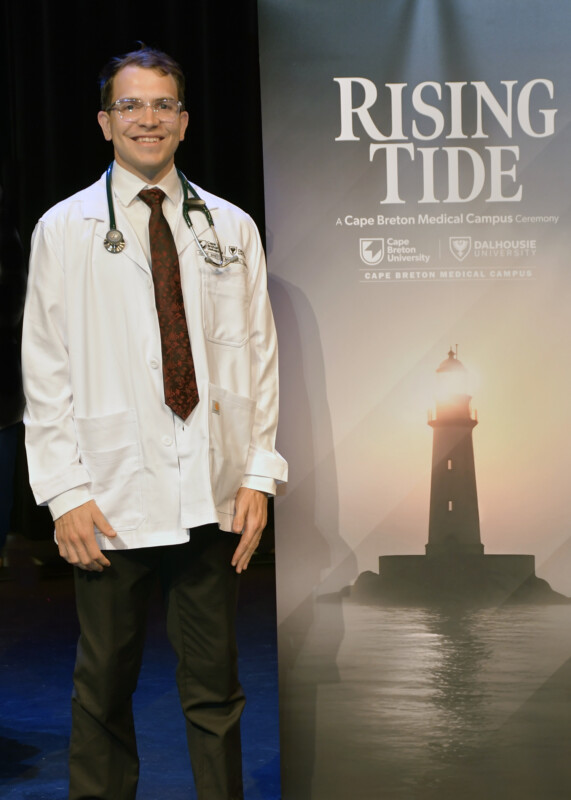 Diagnostic tools give healthcare providers a window into the body, enabling faster and more accurate decisions at a patient’s bedside. That’s why Jack Carmichael, a second-year student at the Cape Breton Medical Campus (CBMC), says he’s intrigued by the role of ultrasound technology in healthcare. His interest in diagnostic tools grew during the first phase of his career as a Registered Nurse. Jack’s nursing studies included a placement at Inverness Consolidated Memorial Hospital, where he saw the benefits of bedside ultrasound in patient care. He’s bringing that experience to his medical studies and hopes to support best practices in patient care, specifically considering the use of diagnostic technology.
“Ultrasound an amazing piece of technology that can easily show healthcare providers what is happening inside the body,” Jack explains. “It’s like the super-stethoscope of the future. I’m interested in the best, most practical way for it to be used more in clinical practice, at the bedside, by physicians.”
After completing his nursing degree at Cape Breton University (CBU) in 2020, Jack spent the next five years working as a Registered Nurse in Chéticamp, a community adjacent to his hometown of Margaree, Nova Scotia. In September 2025, Jack joined the inaugural class at the CBMC. He is now applying his past experience and growing curiosity in ultrasound to his Research in Medicine (RIM) project.
Jack’s RIM project is titled: Impact of a One-Day POCUS Refresher Training on Ultrasound Use in Clinical Practice: A Pre-Post Study. He says he spent the summer working on the curriculum.
“I am hoping to assess or at least make a proof of concept that a single course is possible to administer and then to measure if that course is effective in changing how often doctors use ultrasound in the emergency department.” While Jack is in the early stages of a three-year project, he’s excited to see the impacts.
Research in medicine plays a vital role in healthcare, helping to formulate new treatments and best practices in patient care. It’s a requirement for CBMC students to conduct research during their studies. They are matched with local doctors, who provide guidance and support. Jack says he feels privileged to be working with local physician, Dr. Andrew Holmes.
“I’ve been told that Dr. Holmes is the point of care ultrasound king at the Emergency Department at the Cape Breton Regional Hospital,” Jack says. “He brings real-world knowledge and experience to make this project possible, and he has supervised research on ultrasound education in the past so I’m grateful for his expertise.” Jack says the research is focused on the use of ultrasound in the emergency room.
“One area that we are targeting with our research is the Focused Assessment with Sonography in Trauma (FAST) exam which uses ultrasound to see if there is any major internal bleeding after trauma like car accidents, falls or violent altercations,” Jack explains. “The second area that we are focusing on is pulmonary pathologies, where we can use ultrasound to identify a collapsed lung, pneumonia or fluid in the lungs. All that can be done at the bedside without having to go to the radiology suite and with no exposure to radiation.”
With the support of Dr. Holmes, Jack is designing a one-day ultrasound course for local emergency department physicians. He says those who take the training will be asked to complete three questionnaires: one before the course, one immediately following the course and one three months after the course is finished. “The questionnaires will measure many things, the most important parts being if this course had an impact on how often they used bedside ultrasound in their clinical practice,” he says. “It will give us an idea if the education is worth doing at all. If it proves effective, it could be the start of a new ultrasound education paradigm!”