From Classroom to Lab: Anatomy Education at CBMC
Date Posted: May 25, 2026


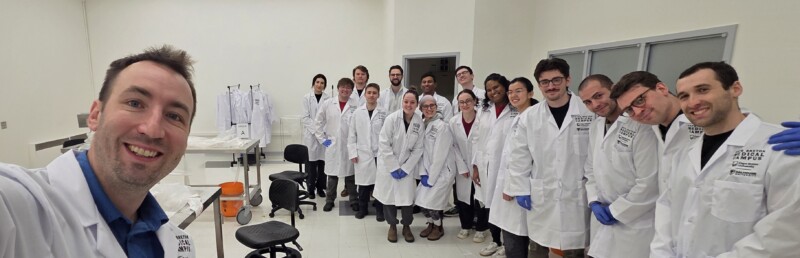
Being part of a new medical campus is a rare opportunity that is not lost on Dr. Dan Hodgson, anatomist at the new Cape Breton Medical Campus (CBMC). Dr. Hodgson joined the CBMC team in late 2025, during construction of the new state-of-the-art facility which officially opened on May 14, 2026.
Dr. Hodgson describes his work as an anatomist at a basic level. “I teach future doctors how the human body is put together and how it works,” he says. “But more than that, I try to help students understand how the body’s structure relates to function. Instead of just memorizing anatomy, we focus on how different parts of the body interact and why that matters for movement, injury and disease.”
A Transformative First Experience in the Anatomy Lab
For most medical students, the anatomy lab offers a completely new experience, one that Dr. Hodgson describes as both exciting and overwhelming.
“Up until that point in their education, anatomy is often diagrams and lecture slides,” he says. “Walking into the lab and seeing real human structures changes that perspective very quickly. For example, when students hold a human brain or heart in their hands for the first time, everything they’ve studied about those structures suddenly becomes tangible and they begin to appreciate the delicacy, complexity and precision of the human body in a completely different way.”
Dr. Hodgson says that’s also the point at which many students begin to appreciate the responsibility that comes with learning from organ and body donors.
“On their first day in the lab, I always tell med students to treat the donor as their first official patient,” Dr. Hodgson says. “That mindset helps ground the experience. It reinforces professionalism, but also reminds them that this is a person who made a meaningful contribution to their training.”
Supporting Student Learning with New Tools and Space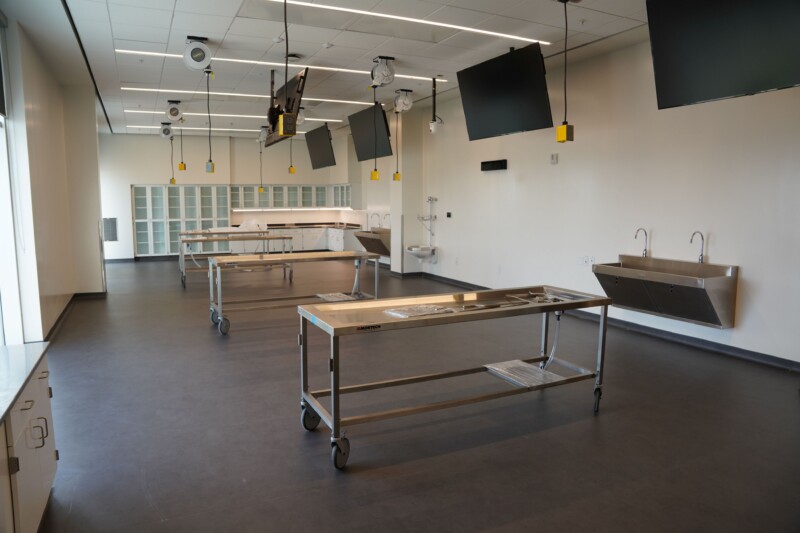
The new CBMC lab features advanced technologies to allow students to visualize samples in 3D, rotate them and explore relationships that can be hard to grasp from a textbook or 2D image. Dr. Hodgson says he’s excited to introduce a modern, fully immersive learning environment that will help students to thrive in the study of anatomy.
“It’s been amazing to be involved in organizing the lab, considering how students will move through the space and how to best integrate different teaching tools and technologies,” says Dr. Hodgson. With a PhD in Sensorimotor Neuroscience from University of Calgary, Dr. Hodgson has seen the evolution of technology and its impact on the study of anatomy.
“What I find most valuable is how technology can complement, not replace, cadaver-based learning,” Dr. Hodgson explains. “Students can build their understanding using digital tools first, then apply that knowledge in the lab where they see real human tissues, textures and anatomical variation.”
Dr. Hodgson’s experience includes his PhD research focused on how the nervous system integrates sensory information to control movement, complementing a Master’s in Exercise Physiology from Memorial University and a Bachelor’s degree in Kinesiology from Ontario Tech University. He says he followed an academic path that aligns with his personal interests in physical fitness, sports, recreation and nature, and says living in Cape Breton is fueling those interests.
“The pace of life, the access to nature and the sense of community all stand out. You can step away from work and be near the ocean within minutes, which is a major advantage for my lifestyle,” says Dr. Hodgson. “I grew up in a small town called Orono, Ontario. It’s the kind of place where you know your neighbours, so coming to Cape Breton actually feels very familiar in that sense.”
As the Cape Breton Medical Campus continues to grow, the combination of new facilities and dedicated educators like Dr. Hodgson is helping to build a strong foundation for medical education in the region—one that will support learners, communities and the future of rural healthcare in Nova Scotia.