Shondra Johnson-Marshall Awarded the Sisters of St. Martha Nursing Scholarship
Date Posted: Apr 17, 2026


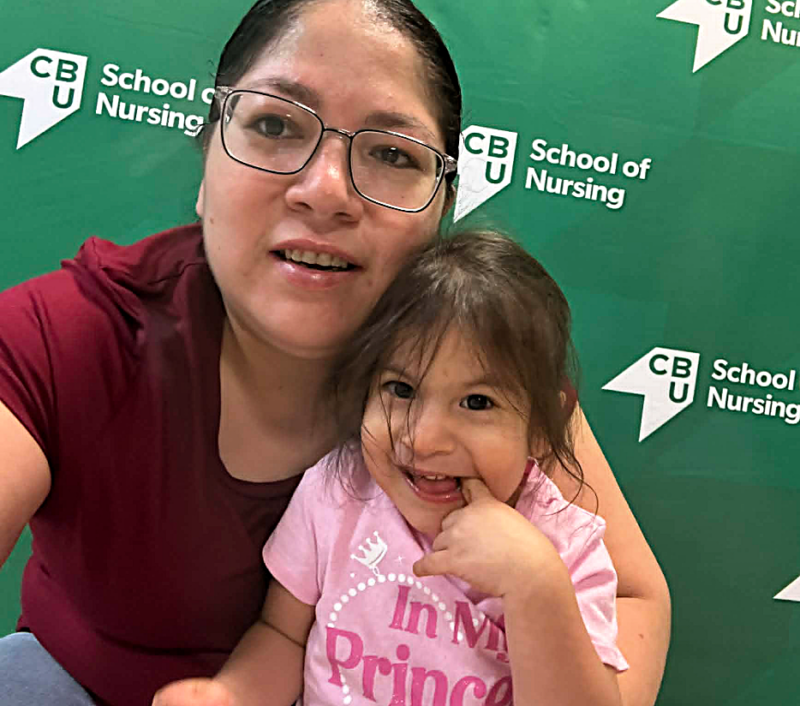 Balancing the demands of a nursing program can be a big challenge for anyone under any circumstances, but Shondra Johnson-Marshall, from Membertou First Nation, is managing her studies and a family of eight at the same time. Currently in her fourth term of the Bachelor of Science, Nursing program at Cape Breton University, Shondra has been named the recipient of the Sisters of St. Martha Indigenous (Mi’kmaw) Nursing Scholarship, a prestigious award valued at $30,000.
For Shondra, the path to nursing began with a harsh financial reality, but it was ultimately driven by a deeper search for purpose. After working on minimum wage for 12 years, she realized she could no longer afford to feed her children on that income. But the drive to become a nurse was about more than just a paycheck.
“I wanted to do something meaningful with my life and wanted to do something that’s been in the back of my mind for years,” Shondra explained. “But I was too scared to do it.”
While on maternity leave, she returned to Sydney Adult High School to get her missing science credits, originally planning to pursue the LPN designation, but eventually Shondra decided to go “all the way” and pursue her RN designation. She started the CBU program when her youngest child (at the time) was just two months old, which meant she frequently had to rush home between classes to care for her newborn.
A Village of Support
Balancing a nursing degree with raising a family is a monumental task. Shondra is quick to credit a village of support for keeping her on track. Her husband, Wesley, has been completely supportive, taking on household responsibilities to ensure she can focus on her education.
“If I’m running late, he’ll have breakfast made… if I’m here studying late, he’ll show up with Tim Hortons,” she shared. “I couldn’t do it without him.”
She has also found a dedicated support system within CBU’s nursing faculty. When she was struggling with her head-to-toe assessments, Rachel Doucette, a Nursing Practice Educator at CBU, went above and beyond in her support for Shondra and her fellow nursing students.
Another instructor helped her overcome her anxiety in pharmacology, leading Shondra to achieve more than she thought possible in the class.
She also credits Indigenous support staff and services at CBU like Lucinda Googoo, the Mi’kmaw Indigenous Nurse Education Specialist on campus, Trudy Paul, another Indigenous Nursing Practice Educator on campus and Unama’ki College, with constant support. Laurianne Sylvester, Dean of Unama’ki College, says Shondra has demonstrated resilience, confidence and determination throughout her Nursing studies.
“Shondra’s remarkable resilience, her dedication to her six children and husband, combined with her sheer determination to succeed in the Nursing program serve as a profound inspiration,” says Sylvester. “We are incredibly proud of her journey and look forward to seeing her carry this legacy forward as a role model and future healthcare advocate for her community.”
The Power of Resilience
Shondra’s journey has not been without its dark moments. During her first term, she experienced the heavy discouragement of failing classes, a moment that makes many students question their future. Yet, instead of giving up, she used the setback as motivation to push harder.
“Like how I failed the classes and I’d had to come back and do it instead of giving up. I just kept going,” she said. “I spiraled a lot during the first term when it was all new. In your mind, you’re like, ‘This is the end of it.” But then you realize it’s not.”
She credits any successes to keeping her main priorities, family and school, focused throughout the challenges.
“I just knew what I wanted,” Shondra says. “I have to do more. I have to show my kids that there’s more to life.”
Representation and Legacy
The Sisters of St. Martha Scholarship was established to honour Sister Veronica Matthews, a pioneering Indigenous nurse from Eskasoni who founded the first certified Indigenous diabetic clinic in Atlantic Canada. The award provides Shondra with crucial financial relief, allowing her to rely less on working outside of school so she can focus on her studies.
Following in the footsteps of Indigenous nurses like Sister Veronica, Shondra is already building her own legacy of representation both at home and in the community. She served as the 2025-2026 Indigenous representative for the CBU Nursing Society and was recently elected for a second term in the 2026-2027 academic year. Looking ahead, she plans to bring that advocacy directly into the healthcare system. Shondra hopes to start her career in the emergency room to increase representative care for Indigenous patients.
“I want to be in the emergency room first,” Shondra noted. “I want people to come in and feel like if they see me, they’ll be okay, they’ll feel like they’ll have someone here to advocate for them or support them.”
Eventually, she hopes to transition to palliative care, bringing with her the cultural understanding of life and passing that is ingrained in Indigenous communities.
“Being Native, we’ve been around death our whole lives, it’s a part of our culture,” Shondra says. “It’s like part of life. I think, with my knowledge and my experiences, I would be good there.”
Ultimately, Shondra’s journey is about proving what is possible. Whether she is serving as a voice for Indigenous students on campus, an advocate for Indigenous patients in care or showing her children that dreams are possible.
“I want people to see someone who followed their dreams, and realize it’s never too late,” Shondra said. “They can do it too.”