Cape Breton Medical Campus Student Launches Stem Cell Registry Drive at CBU
Date Posted: Mar 16, 2026


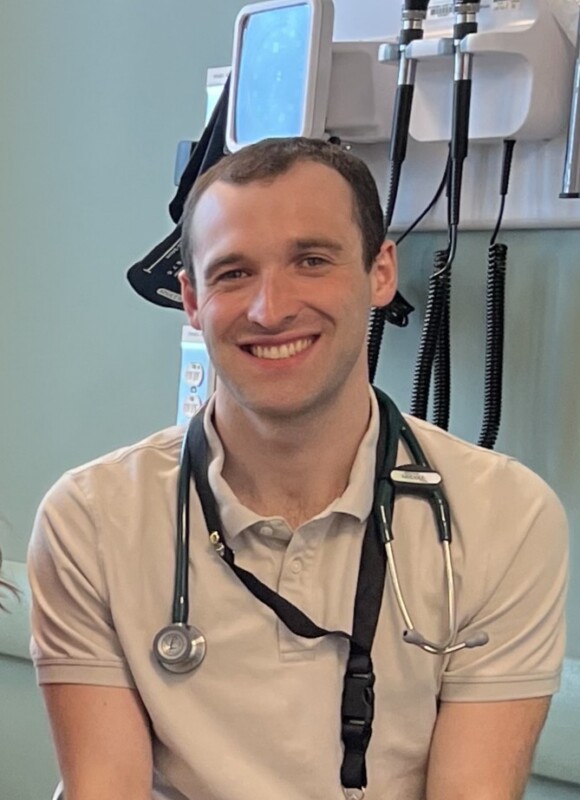 First-year medical student, Oliver Schnare, is part of the inaugural class of students at the new Cape Breton Medical Campus (CBMC), where he’s pursuing a career in family medicine along with 29 classmates. Raised in New Glasgow, Oliver brings a community spirit that is nurtured in rural Nova Scotia living, where people come together in times of challenge. He’s showing this sense of community within the Cape Breton University (CBU) campus, urging people to get involved in a life-saving mission.
Oliver has organized a stem cell registry drive at CBU, taking place on March 24 and 26. The event is a collaboration with Canadian Blood Services and will provide an opportunity for CBU students, staff and faculty to join the stem cell registry. The registry is an international repository of potential donors, where critically ill patients hope to find a stem cell match as a life saving intervention, including people with leukemia or multiple myeloma. Oliver explains that joining the registry involves a simple mouth swab.
“During the event on campus, we will be doing the actual swabs, guided by Canadian Blood Services,” Oliver says. “They lead Canada’s participation in the stem cell donor program as part of an international consortium.”
Oliver says he’s been connected to the work of Canadian Blood Services since high school, when a friend was diagnosed with leukemia.
“When someone you know is sick, you feel helpless, but there is a way to make a difference,” Oliver explains. “That motivated us to hold a blood donor clinic at our high school, to support people like our friend who are counting on blood donors to give them a fighting chance.”
Since then, Oliver has been donating blood several times a year. He hoped to continue this practice when he relocated to Sydney to attend CBMC. As he was searching for a local blood donor clinic, he learned that the closest location is over an hour away in Port Hawkesbury. He connected with Canadian Blood Services to learn about other options. That’s when he was advised of the pressing need to build the stem cell registry.
“It’s one of those situations where there’s strength in numbers,” Oliver explains. “Only one per cent of the people who volunteer for the stem cell registry will be identified as a match. That’s why numbers matter.”
Canadian Blood Services promotes the opportunity for university communities to host stem cell drives. Its current campaign, Give and Get Away, is a campus swab event taking place at post secondary schools across the country, offering a chance to win a trip for two to any Air Canada scheduled destination worldwide.
Canada’s national stem cell registry should be as diverse as our country.
Oliver’s research into stem cell donation made it clear that CBU offers an amazing opportunity to support the registry.
“Many people have difficulty finding a match due to a lack of diversity in stem cell registries around the world,” he says. “We need donors with all types of ancestral backgrounds, so we hope to represent the fabric of CBU’s wonderfully diverse community in the upcoming drive.”
Some patients have many potential donors because they have inherited commonly found genetic markers on their white blood cells. “These markers vary across different ethnic groups, for instance, those common in people of European descent may rarely be found in the Asian population, and vice versa,” Oliver explains. He adds that minority groups are least represented in the registry, often times due to lack of opportunity to participate in stem cell drives.
While not always the case, Oliver says patients are more likely to find a matching donor among those who share their ethnic ancestry, which makes a diverse donor base extremely important. “If you come from an ethnically diverse or mixed-race background, your donation could be the life saving match a patient has been waiting for,” Oliver says.
Everyone is encouraged to join the stem cell drive on March 24, 11:30am-2:00pm and March 26, 10:00am-2:00pm, near the CBU cafeteria. Oliver and other volunteers, supported by Canadian Blood Services, will be available to respond to questions from participants, collect swabs and explain the importance of this work.